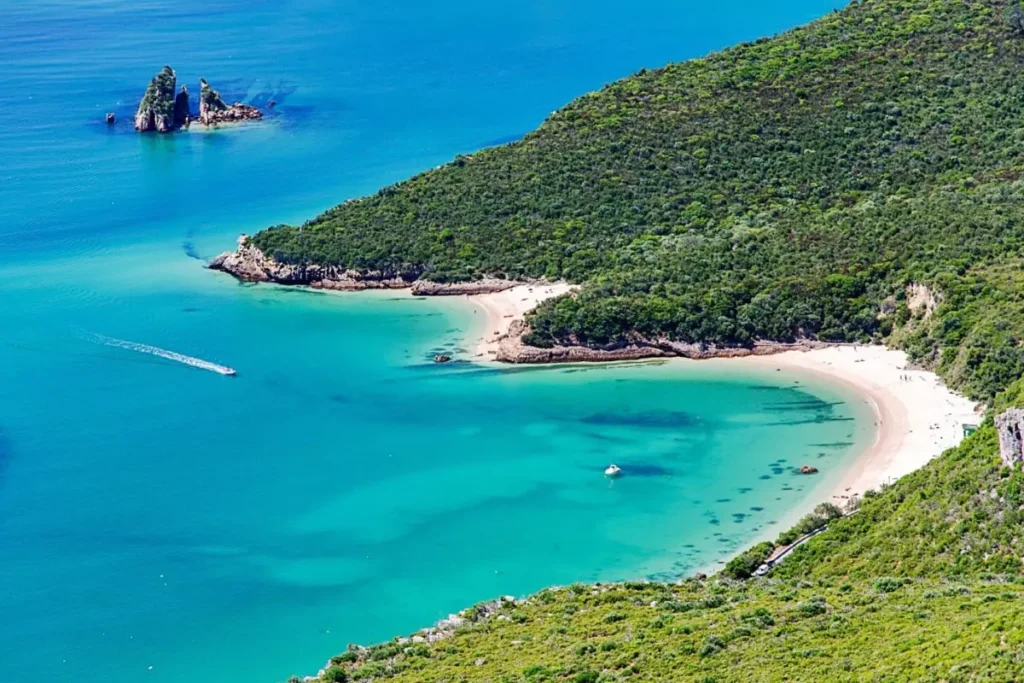
Arrábida Natural Park is a protected natural park and UNESCO Biosphere Reserve located 45 minutes south of Lisbon, on the Setúbal Peninsula. Known for its turquoise beaches, white limestone cliffs, hiking trails, Azeitão wines and dolphin-watching opportunities in the Sado Estuary, it is widely considered one of Portugal’s most beautiful coastal destinations and one of the best day trips from Lisbon.
Quick facts
- Location: Setúbal Peninsula, between Sesimbra and Setúbal
- Established: 28 July 1976, Decree-Law 622/76
- Area: 176.41 km² (123.30 km² on land, 53.11 km² of protected sea)
- Highest point: Pico do Formosinho, 501 m
- Managed by: ICNF (Institute for Nature and Forest Conservation)
- Distance from Lisbon: ~45 minutes by car
- Best time to visit: May to September for beaches, year-round for hiking and wine
- How to visit: Self-drive, or a private guided tour from Lisbon
Why is Arrábida famous?
Rather than becoming another heavily developed beach destination, Arrábida has stayed remarkably untouched thanks to decades of environmental protection under ICNF, Portugal’s nature conservation authority. Visitors come here for a combination that’s genuinely hard to find elsewhere in Europe:
- Crystal-clear turquoise water, closer in colour to the Mediterranean than the open Atlantic
- White limestone cliffs dropping straight into the sea
- One of Portugal’s most scenic coastal roads, connecting Setúbal to Sesimbra
- Praia dos Galapinhos, repeatedly ranked among Europe’s best beaches
- A resident population of bottlenose dolphins in the Sado Estuary, one of only two in Portugal
- Azeitão’s Moscatel wine and Queijo de Azeitão cheese
- The 16th-century Convento da Arrábida, perched above the cliffs
- Rare Mediterranean-type vegetation, including around 30 native orchid species according to ICNF botanical records
Where is Arrábida and how do you get there?
Arrábida sits on the Setúbal Peninsula, across the Tagus estuary from Lisbon, stretching between the fishing town of Sesimbra and the city of Setúbal. There’s no direct train, unlike Cascais or Sintra, which is part of why it stays quieter: reaching it takes some planning, whether by car, organized tour, or a combination of bus and local transfers.
For travelers without a rental car, a private day tour from Lisbon is the simplest way to cover the park’s viewpoints and beaches without navigating narrow coastal roads or relying on infrequent local buses. If you’re planning several days in the region, it also pairs naturally with a broader look at what to do in Lisbon or a multi-day itinerary across Portugal.
Local insight
Locals rarely spend the entire day on one beach. Most combine a morning at Portinho da Arrábida with lunch and wine tasting in Azeitão, then finish the afternoon walking around Sesimbra’s old town and castle. This is also how most private tours through the region are designed, splitting the day between coast, countryside and a fishing town rather than parking at a single beach.

Best things to do in Arrábida
Visit Portinho da Arrábida
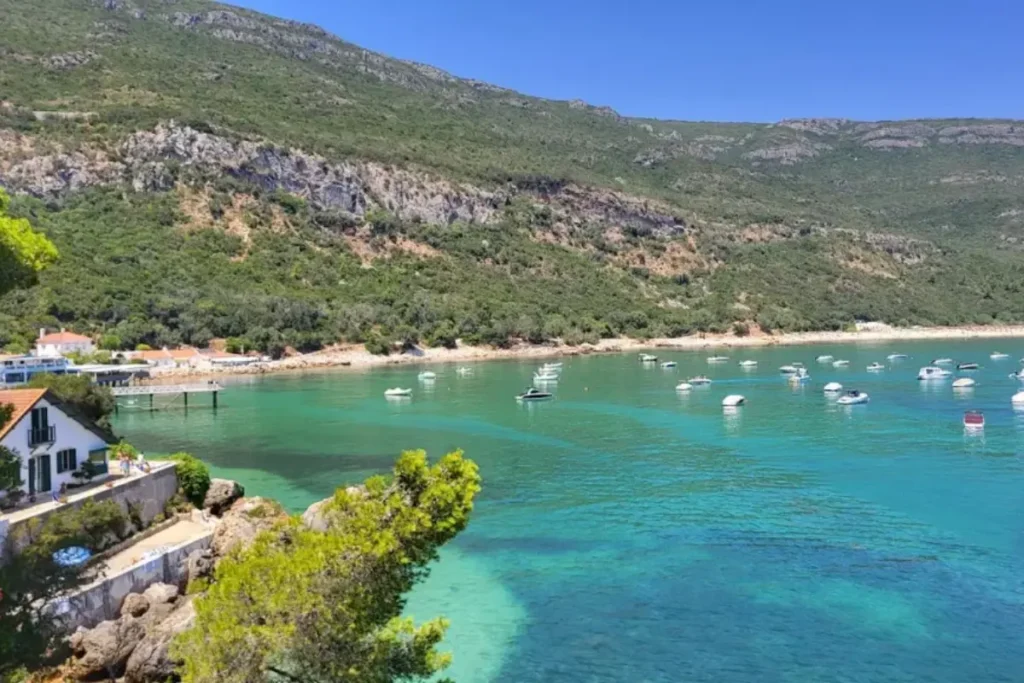
The park’s most iconic beach, a sheltered cove with calm, shallow, turquoise water backed by pine-covered cliffs, and one of the few in the park with parking directly on site. It gets busy by mid-morning in summer, so an early start or a guided visit timed outside peak hours makes a real difference. Praia dos Galapinhos, just around the headland, is reachable only on foot or by boat, which is part of why it has stayed so pristine.
Enjoy the hidden viewpoints
Beyond the well-known beaches, the coastal road holds several miradouros that most visitors drive past. The Miradouro do Portinho and the stretch of road climbing toward the Convento offer some of the best photography spots in the park, with far fewer people than the beaches below.
Hike to Convento da Arrábida
A 16th-century convent built into the cliffside, reachable via a hiking trail with panoramic views over the Sado Estuary and Tróia Peninsula along the way. The convent itself has limited public access, guided visits are possible on specific days, but the trail and viewpoints are open year-round.
Taste Moscatel de Setúbal
The Azeitão region on the park’s edge is home to some of Portugal’s best-known wine producers, historically famous for Moscatel de Setúbal, a fortified dessert wine. Pairing a tasting with lunch is the standard way locals spend a slower afternoon here.
Explore Azeitão
Beyond wine, Azeitão is known for Queijo de Azeitão, a soft sheep’s cheese with DOP status, and for a handful of historic quintas worth a short stop even for travelers who aren’t wine drinkers.
Go dolphin watching
Boats depart from Sesimbra and Setúbal to the Sado Estuary, home to one of only two resident bottlenose dolphin populations in Portugal. Sightings aren’t guaranteed on any wildlife trip, but the estuary population is resident rather than migratory, which makes encounters relatively consistent through the year.
Visit Sesimbra
A working fishing town at the park’s western edge, with a hilltop Moorish-era castle, a long town beach, and some of the region’s best fresh seafood restaurants.
Enjoy the panoramic viewpoints
The coastal road between Setúbal and Sesimbra passes several miradouros looking out over the cliffs and the Atlantic, worth the stops even for travelers short on time.
Is Arrábida worth a day trip from Lisbon?
For most travelers, yes, particularly if Lisbon, Sintra or Cascais are already on the itinerary. Arrábida offers a different pace: fewer crowds, more nature, and a slower, food-and-wine-focused day rather than a checklist of monuments. It’s less suited to travelers with only a few hours to spare in Lisbon, since the round trip alone takes over an hour and the park rewards unhurried exploration rather than a quick stop.
One-day Arrábida itinerary
- 09:00 – Depart Lisbon
- 10:00 – Coastal viewpoints along the Setúbal–Sesimbra road
- 11:00 – Portinho da Arrábida beach
- 13:00 – Lunch in Azeitão
- 15:00 – Wine tasting, Azeitão
- 17:00 – Sesimbra old town and castle
- 18:30 – Return to Lisbon
This is roughly the structure of our own private Arrábida tour, adjusted on the day depending on the season and group interests.
Tips before visiting Arrábida
- Car access is restricted in summer. Under the municipal “Arrábida Sem Carros” program, private vehicles are banned outright from Albarquel and Figueirinha beaches, daily from 7am to 8pm, between early June and mid-September. Access to Portinho da Arrábida, Creiro and Galapos is conditional and closes once designated parking fills up.
- Public transport (bus lines integrated with the Navegante pass) is the main alternative during the summer restrictions, with more frequent departures in July and August
- There’s no entrance fee to the park itself
- The road between the Figueirinha tunnel and Galapos is permanently closed to vehicles and pedestrians due to rockfall risk, this isn’t seasonal
- Bring water and sun protection, shade is limited on most beaches
- Mobile coverage can be patchy in the more remote stretches of the park
- Restaurants in Azeitão and Sesimbra get busy at lunchtime in summer, book ahead if possible
Common mistakes visitors make
- Planning to self-drive to Figueirinha or Albarquel in summer without checking the car ban first
- Arriving without a plan when the Portinho/Creiro/Galapos road closes for the day
- Spending the whole day at one beach instead of pairing the coast with Azeitão or Sesimbra
- Assuming Galapinhos has parking or vehicle access, it’s foot or boat access only
- Not booking lunch in Azeitão or Sesimbra ahead of a summer weekend
- Not checking whether current-season access rules affect the specific beach they’re planning to visit
Arrábida vs Cascais: how do they compare?
Arrábida | Cascais | |
Distance from Lisbon | ~45 min by car | ~30 min by car or train |
Access | Car or organized tour | Train, direct from Lisbon |
Atmosphere | Protected natural park, quieter | Coastal town, restaurants and shops |
Beaches | Turquoise water, cliffs, limited parking | Sandy town beaches, easy access |
Best for | Nature, hiking, quieter beach days | Convenience, dining, a half-day trip |
Crowds in summer | Lower, access is naturally limited | Higher, especially July–August |
Both are valid choices, and many travelers combine a stop in Cascais with a full day in Arrábida on longer trips. If you’ve already done Cascais, or you want a beach day without the crowds, Arrábida is the natural next step. For a shorter, easier-to-reach coastal day, our Sintra and Cascais private tour covers both in one outing.
When to visit Arrábida
Summer (June to September) is best for beaches and boat trips, though weekends get busy at the most photogenic spots like Galapinhos. Spring and autumn are better for hiking and wine tasting without the summer heat, with the trails and viewpoints largely to yourself.
How to visit Arrábida with a private guide
Arrábida’s summer car restrictions make self-driving genuinely impractical for some of the park’s best beaches, not just inconvenient. At Portugal Guided Tours, our private Arrábida tour covers the park’s main viewpoints, a beach stop, and the Azeitão wine region in a single day, with pickup from central Lisbon.
It’s designed around the same rhythm locals use: coast in the morning, food and wine in the afternoon, rather than a single long beach stop. If you’re planning a longer trip, take a look at our full range of private tours across Portugal or browse all our tours.

Frequently Asked Questions about Arrabida Natural Park
Is Arrábida better than Cascais?
They serve different purposes. Cascais is easier to reach and better for a short half-day trip with dining and shopping. Arrábida is better for a full day focused on nature, hiking and quieter beaches, and works well as an alternative for travelers who want to avoid summer crowds.Is Arrábida worth a day trip from Lisbon?
Yes, particularly for travelers who have already spent time in Lisbon, Sintra or Cascais and want a quieter, nature-focused day. Its beaches are consistently ranked among the best in Portugal, though the round trip takes over an hour, so it suits a full day rather than a quick stop.How do you get to Arrábida from Lisbon without a car?
The most reliable option without a rental car is an organized tour with pickup from central Lisbon, since there’s no direct train and local bus connections are limited.Can you see dolphins in Arrábida?
Yes. Boat trips from Sesimbra and Setúbal regularly spot wild dolphins in the Sado Estuary, one of only two resident bottlenose dolphin populations in Portugal.What is the best beach in Arrábida?
Praia dos Galapinhos is the most famous and photographed, but Portinho da Arrábida is easier to access and better suited to families, and Praia da Figueirinha has the most facilities.Can you drive to the beaches in Arrábida in summer?
Not everywhere. Under the municipal “Arrábida Sem Carros” program, private cars are banned outright from Figueirinha and Albarquel beaches, daily from 7am to 8pm, between early June and mid-September. Access to Portinho da Arrábida, Creiro and Galapos is conditional and closes once designated parking is full. Public transport and organized tours are the more reliable options during this period.When was Arrábida Natural Park created?
The park was established on 28 July 1976 by Decree-Law 622/76, and later expanded in 1998 to include a protected marine area along the coast.Is there an entrance fee for Arrábida Natural Park?
No, there’s no entrance fee to access the park or its beaches.Is Arrábida suitable for children?
Yes, particularly Portinho da Arrábida and Praia da Figueirinha, both of which have calm, shallow water and easy parking access. Galapinhos, reachable only on foot, is less practical with young children.Is parking difficult in Arrábida?
Yes, especially in summer. The main beaches have limited parking that fills up by mid-morning on sunny days, which is one of the main reasons visitors choose an organized tour instead of self-driving.